


puttering targets are no stranger to those in the materials field, but for friends outside this industry, it might be the first time they’ve heard the term. So today, let’s use plain language to talk about everything you need to know about sputtering targets.
I. Breaking Down the Name: Why Is It Called a “Sputtering Target”?
The name sounds quite intimidating, but it’s actually straightforward once you break it down.
“Target” — it’s a piece of material that serves as a “target.” Inside the equipment, it’s the one being bombarded.
“Sputtering” — that’s the bombardment process. High-energy particles hit the target like bullets, knocking atoms off the target surface—like mud splashing—and those atoms deposit onto another surface, forming a thin film.
So put together: sputtering target = the target used for sputtering. The name is its own instruction manual.
Classification of Sputtering Targets
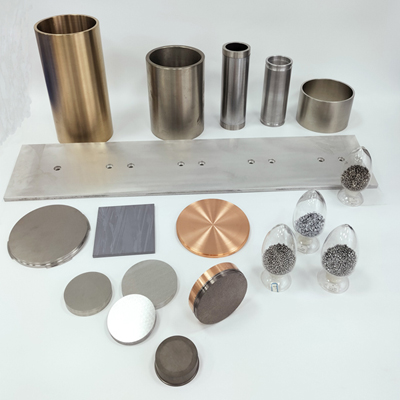
By chemical composition, they can be divided into:
Metal targets (e.g., aluminum, copper, titanium, tantalum, etc.)
Alloy targets (e.g., nickel-chromium, aluminum-silicon, titanium-tungsten, etc.)
Ceramic compound targets (e.g., ITO, zinc oxide, silicon nitride, etc.)
By shape, there are:
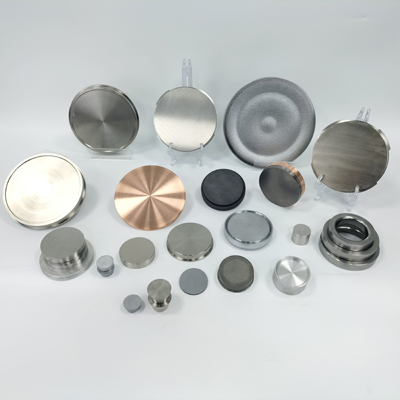
Planar targets (circular or rectangular flat plates)
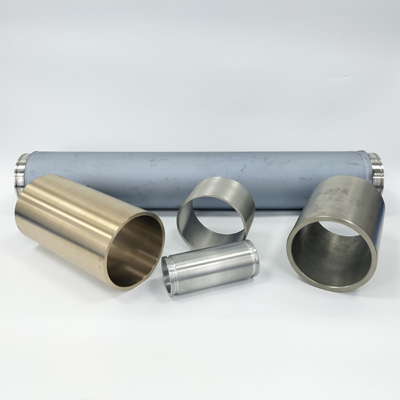
Rotary targets (cylindrical, with higher utilization efficiency)
Production Methods are selected based on material characteristics:
Melting and Casting is suitable for metals and alloys with good plasticity, such as aluminum, copper, and titanium. Through melting, casting, rolling, and heat treatment, targets with high purity and high density can be produced on a large scale.
Powder Metallurgy is used for high-melting-point metals like tungsten and molybdenum, brittle materials, and alloys where compositional uniformity is difficult to achieve. High-purity powders are formed through cold pressing, vacuum hot pressing, or hot isostatic pressing (HIP) and then sintered, resulting in targets with uniform composition and fine grain structure.
Thermal Spraying is mainly used for large-size, tubular (rotary) targets and repair of spent targets. Through plasma spraying or similar methods, molten or semi-molten powder is sprayed onto a substrate and built up layer by layer. This approach breaks size limitations and reduces production costs, though density is typically lower than the previous two methods.
In short: melting focuses on metallic plastic materials, powder metallurgy focuses on high-melting-point and brittle materials, and spraying excels in large-size and rotary target applications.
II. What Does a Target Look Like? Does It Have a “Racetrack”?
Yes, it does.
If you’ve ever seen a used planar target, you’ll notice a closed-loop groove on the surface, like a “racetrack” carved into it. That’s the classic mark left by magnetron sputtering.
Why does this happen? Because the magnetic field inside the equipment confines the plasma in a closed-loop region, so ions concentrate their bombardment on that specific area. Over time, the racetrack appears. This is also a sign that the target has been fully utilized.
However, not all sputtering leaves a racetrack. A rotary target is like a rotating cylinder—it rotates while being used, so the entire surface is consumed evenly, and no fixed groove appears.
III. Are Targets Only Used for “Magnetron Sputtering”? Not at all.
Many people have this misconception: because magnetron sputtering is the most common, they assume targets are only used for it.
That’s not true. Sputtering is a large family, and magnetron sputtering is just the most famous “big brother” of the group.
Here’s a brief introduction to other members:
Diode Sputtering: Simple in structure, but slow—like a skilled craftsman, steady but methodical.
RF Sputtering: Specifically designed for insulating materials like ceramics and glass.
Reactive Sputtering: Oxygen or nitrogen gas is introduced during sputtering, allowing metal atoms to react with the gas and form oxide or nitride films.
Ion Beam Sputtering: High precision, suitable for producing high-quality multi-component films.
Our targets can be used in all these technologies. As long as it’s a sputtering process, a target is indispensable.
IV. Why Are These Small Targets So Important?
Because they are the “raw material warehouse” for thin films.
Many of the things you interact with every day rely on targets:
Your phone screen — the transparent conductive film is sputtered from a target.
Computer chips — the metallic interconnects inside come from ultra-high-purity metal targets.
Energy-efficient architectural glass — the heat-reflective and insulating coatings are sputtered from targets.
Solar cells — the functional layers that improve photoelectric conversion efficiency are also contributed by targets.
Potato chip bags — the aluminized film inside is also the result of sputtering.
A small target sits behind a vast range of high-tech industries: smartphones, displays, semiconductors, photovoltaics, optical coatings, and more.
In Conclusion
A sputtering target is simply the “target” that gets bombarded during the sputtering process. It’s not exclusive to magnetron sputtering—it’s the core consumable across the entire field of sputter deposition.
As a manufacturer, our job is straightforward: turn materials into the targets you need.
Beijing RuiChi Advanced Materials Co., Ltd. specializes in four main business areas:
- Sputtering Targets — covering most metals and alloys, used in various coating applications.
- Special Alloys — including high-temperature, corrosion-resistant, and wear-resistant alloys; elastic, expansion, and soft magnetic alloys; rods for 3D printing powder production; and various consumables.
- High-Purity Materials — including high-purity aluminum, high-purity copper, high-purity nickel, high-purity chromium, high-purity titanium, as well as gold, silver, platinum, indium, and other materials and evaporation pellets.
- R&D Services — with strong R&D capabilities, comprehensive laboratory equipment, and extensive material development experience, we specialize in providing materials R&D and experimental services—including vacuum melting, forging, rolling, machining, and heat treatment—to universities, research institutes, and enterprises.
We have collaborated with numerous universities, enterprises, and research institutes to develop over 5,000 to 6,000 new materials, and have built a materials database that provides powerful digital support for future material development.
If you’re not from this industry, I hope this article makes you feel less unfamiliar the next time you see “sputtering targets.” If you’re a fellow professional in the field, welcome—let’s connect and exchange ideas.
Post time: Jun-17-2026