

Master alloys, also known as intermediate alloys, are special alloys made by pre-melting one or more elemental elements together with a certain metal as the base. The base metal content is typically greater than or equal to 50%. They cannot be used directly for casting parts or fabricating structural components; rather, they are “additive-type functional materials” dedicated to the accurate introduction of elements and composition adjustment during the smelting process.
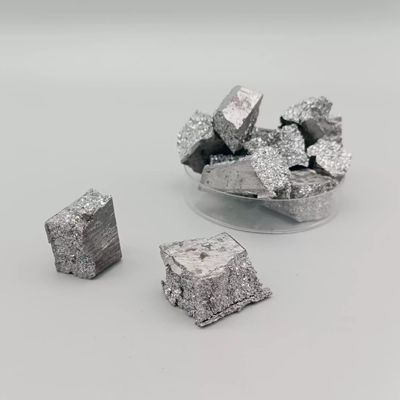
Their emergence addresses the practical difficulties of directly adding elemental elements into the melt. Certain elements have extremely high melting points, and direct addition requires extreme temperatures; certain elements are chemically active and burn away severely once charged into the melt; still others have densities vastly different from the base metal and are prone to segregation. After being made into master alloys, the melting point is usually lower than that of the refractory element itself, dissolution is faster, recovery is more stable, and distribution is more uniform.
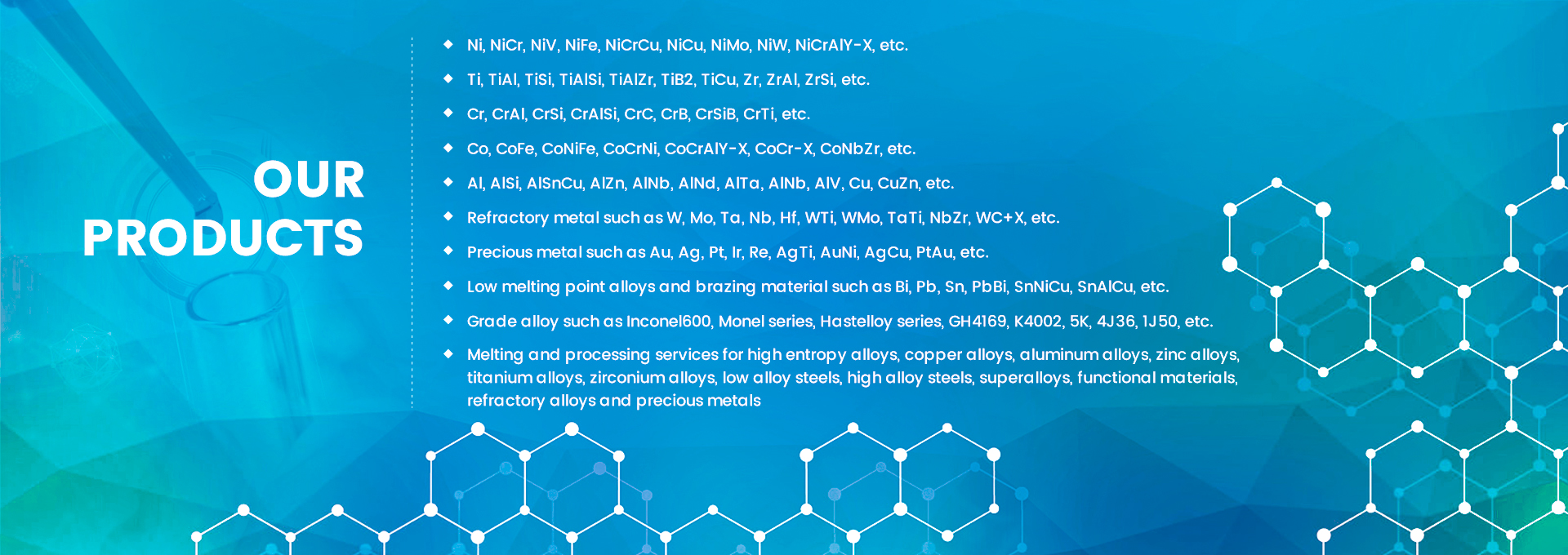
By base metal, master alloys can be divided into aluminum-based, copper-based, nickel-based, iron-based, etc.; by application, they cover alloying-type, grain-refining-type, modifying-type, purifying-type, and deoxidizing/desulfurizing-type categories.
Core Functions of Master Alloys
The value of master alloys is concentrated in their ability to make difficult-to-handle additive elements tame and controllable. Specifically, their functions are manifested at the following levels:
Overcoming the difficulty of melting in high-melting-point elements. Elements such as tungsten, molybdenum, zirconium, and titanium have extremely high melting points; direct charging into the melt requires significantly higher temperatures and longer melting times, exacerbating the burning loss and gas absorption of the base metal. After being made into master alloys, the melting point drops significantly, allowing smooth melting at conventional smelting temperatures.
Suppressing the loss of easily burned elements. Elements such as magnesium, calcium, lithium, and boron are chemically active or have high vapor pressure at elevated temperatures, and direct addition readily reacts with furnace gases or slag. Pre-alloying protects these elements through the carrier upon addition, allowing them to stably enter the final alloy melt and ensuring compositional accuracy.
Overcoming density differences and segregation tendencies. When the added element and the base metal differ vastly in density, direct addition tends to cause compositional inhomogeneity due to gravity. Master alloys, through pre-uniform distribution, enable the added elements to disperse rapidly after addition, avoiding local segregation.
Achieving grain refinement and microstructure control. Aluminum-titanium-boron and similar master alloys release a large number of heterogeneous nucleation cores upon addition to the melt, acting as external nuclei during solidification, significantly refining grains and enhancing mechanical properties and processing performance.
Improving production efficiency and compositional precision. Furnace-side operations only require weighing and adding master alloys according to the target composition, without on-site handling of refractory or fragile elemental raw materials, shortening the smelting cycle and reducing repeated adjustments caused by off-spec composition.
How Rich Special Materials Co.,Ltd. Prepares Master Alloys
Rich Special Materials Co.,Ltd. is not a company whose sole flagship product is master alloys, but its accumulation in vacuum melting and special alloys constitutes a practical capability for preparing master alloys.
Vacuum melting equipment covers the scale from scientific research to batch production. The company currently has multiple sets of vacuum melting equipment, including vacuum induction furnaces, vacuum magnetic levitation melting furnaces, and vacuum arc furnaces, with capacities ranging from 50 grams to 500 kilograms. It can melt and purify almost all transition group metals and alloys, meeting the needs of different stages from material trial production and pilot testing to batch production. Master alloys have high requirements for compositional uniformity and impurity control, and the vacuum environment effectively avoids oxidation and gas contamination, making it the core means for preparing high-quality master alloys.
Special alloy melting experience directly supports master alloy preparation. In the production of special alloys such as Stellite, K4002, K418, GH4169, GH625, Inconel600, Hastelloy, and Monel, Ruichi has accumulated practical capabilities in composition control, crucible selection, melting processes, and casting processes. The company’s technical personnel have melted more than 6,000 types of materials, with deep attainments in raw material selection, crucible selection, composition control, and melting and casting processes. This experience can be directly transferred to the preparation of master alloys.
Customized melting services match the production characteristics of master alloys. Ruichi provides vacuum melting experimental services to universities, research institutes, and enterprises, covering the melting of special alloys and high-entropy alloys such as aluminum-based, copper-based, iron-based, nickel-based, and cobalt-based alloys. This flexible model aligns with the characteristics of master alloys—”many varieties, flexible batch sizes, and precise composition requirements.” Public information also shows delivery records of customized melting orders such as copper-titanium-nickel alloys, with customers acknowledging the finished product quality.
In summary, Rich Special Materials Co.,Ltd. preparing master alloys is clear: using vacuum melting equipment as the means, more than 6,000 types of material melting experience as the guarantee, and customized services as the form, completing the preparation process from raw material proportioning to alloy ingots.
Although master alloys do not directly constitute final products, they are a critical link between raw materials and finished products. Their quality directly affects the compositional precision and performance stability of the final alloys. Rich Special Materials Co.,Ltd. relying on multiple sets of vacuum melting equipment—including vacuum induction furnaces, vacuum magnetic levitation melting furnaces, and vacuum arc furnaces—as well as process accumulation from melting more than 6,000 types of materials, can provide customized melting services for various master alloys, including aluminum-based, copper-based, nickel-based, iron-based, and cobalt-based alloys, to universities, research institutes, and enterprises. With capacities ranging from 50 grams to 500 kilograms, the company meets the diverse needs from scientific research trials to batch production. Whether it is the alloying of refractory elements, the stable introduction of easily burned elements, or the preparation of grain-refining master alloys, Rich Special Materials Co.,Ltd. possesses the corresponding equipment foundation and process capabilities. Institutions with master alloy melting needs are welcome to contact us to jointly advance material R&D and production.
Post time: Oct-31-2026