


1. Why Atomic Ratio and Weight Ratio Must Be Clearly Distinguished
In the procurement and technical communication of TiAl targets, there is a question that comes up almost every day: a customer says, “I want a TiAl 50/50 target,” and the supplier has to ask, “Do you mean atomic ratio or weight ratio?”
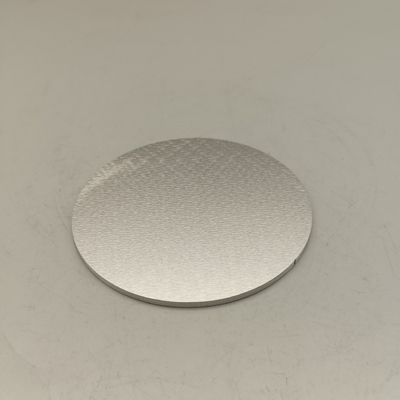
This is not an unnecessary formality. The difference between the two is large enough to change the nature of the material. Titanium has an atomic weight of 47.87, while aluminum has an atomic weight of 26.98. A titanium atom is nearly twice as heavy as an aluminum atom. This means that the same atomic ratio will appear as a completely different value when expressed by weight.
Take the most common TiAl 50/50 at.% as an example. Its atomic ratio is Ti:Al = 50:50, but when converted to mass ratio it is approximately Ti:Al ≈ 64:36, meaning titanium accounts for 64 wt.% and aluminum for 36 wt.%. Conversely, if a supplier interprets “half titanium and half aluminum” by weight and supplies an Al:Ti = 50:50 wt.% target, the atomic ratio becomes approximately Al:Ti ≈ 64:36 at.%, meaning the aluminum content is far higher than intended. The coating will then become brittle and spall due to excess aluminum.
This difference directly determines coating performance. Atomic percentage determines the crystal structure, phase composition, and intrinsic physical and chemical properties of the material, while weight percentage only reflects the weight proportion of the elements in the target. Therefore, in target selection and procurement, clearly specifying “at.%” or “wt.%” is an unavoidable step.
2. Conversion Method Between Atomic Ratio and Weight Ratio
2.1 Basic Formulas
Converting from atomic percentage to weight percentage is straightforward. For a binary Ti-Al system, let the atomic percentage of Ti be
at.%Ti and that of Al be at.%Al (the two sum to 100). Then: wt.%Ti=at.%Ti×MTi+at.%Al×MAlat.%Ti×MTi×100%
wt.%Al=at.%Ti×MTi+at.%Al×MAlat.%Al×MAl×100%
where MTi=47.87 g/mol and MAl=26.98 g/mol.
To convert from weight percentage back to atomic percentage, the formula is symmetric:
at.%Ti=wt.%Ti/MTi+wt.%Al/MAlwt.%Ti/MTi×100%
2.2 Calculation Examples for Typical Compositions
Take TiAl 33/67 at.% as an example to verify the conversion:
Mass fraction of Ti: 33×47.87+67×26.9833×47.87×100%=1579.7+1807.71579.7×100%=46.63%
Mass fraction of Al:1579.7+1807.767×26.98×100%=53.37%
The calculated result is Ti:Al = 46.63:53.37 (wt.%), which agrees closely with the actual batching ratio used in patent literature (46.65 parts titanium powder to 53.35 parts aluminum powder).
Now consider TiAl 50/50 at.%: the mass fraction of Ti is 50×47.87+50×26.9850×47.87×100%=63.95%, and Al is 36.05%. The corresponding patent batching ratio is “63.95 parts titanium powder and 36.05 parts aluminum powder,” which is completely consistent. This result also agrees with data published by manufacturers .
3. Comprehensive Atomic Ratio–Weight Ratio–Density Table for TiAl Targets
The table below summarizes the conversion results and guaranteed densities for common TiAl target compositions.
| Atomic ratio (at.%) | Weight ratio (wt.%) | Guaranteed density (g/cm³) | Thermal conductivity (W/(m·K)) | CTE (×10⁻⁶/K) |
|---|---|---|---|---|
| Ti25 / Al75 | Ti 37.2 / Al 62.8 | 3.11 | 115 | 21 |
| Ti30 / Al70 | Ti 43.2 / Al 56.8 | 3.20 | — | 18 |
| Ti33 / Al67 | Ti 46.6 / Al 53.4 | 3.26 | 102 | 16 |
| Ti40 / Al60 | Ti 54.2 / Al 45.8 | 3.38 | — | 13 |
| Ti50 / Al50 | Ti 64.0 / Al 36.0 | 3.56 | 61 | — |
| Ti70 / Al30 | Ti 80.5 / Al 19.5 | 3.95 | — | — |
| Ti75 / Al25 | Ti 84.2 / Al 15.8 | 4.00 | 30 | — |
One noteworthy pattern: the higher the aluminum content, the lower the target density. From 4.00 g/cm³ for Ti75/Al25 to 3.11 g/cm³ for Ti25/Al75, density decreases by about 22%. This is directly related to the light weight of aluminum (pure aluminum density is only 2.7 g/cm³, while pure titanium is 4.51 g/cm³). Therefore, when purchasing targets by weight, a high-aluminum target of the same volume will be noticeably lighter. The pricing method—by weight or by volume—should be confirmed with the supplier in advance.
4. Several Key Practical Points
Weight ratios must be used in batching. When preparing TiAl targets by powder metallurgy, the metal powders are weighed, so the design target (usually an atomic ratio) must first be converted into a weight ratio before batching. For example, to prepare a TiAl 33/67 at.% target, the actual weighed charge should be about 46.65 parts titanium powder and 53.35 parts aluminum powder, not 33 parts and 67 parts.
Density values depend on the process route. The guaranteed densities listed in the table above are typical values for powder metallurgy (HIP) processes. For targets of the same composition prepared by melting, actual density may differ from the table values due to possible compositional segregation and differences in porosity. During procurement, an Archimedes density test report for the specific batch should be requested from the supplier.
The “lighter” density of high-Al targets is normal. If you receive a Ti25/Al75 at.% target and find that it is considerably lighter than a Ti75/Al25 target of the same dimensions, this is a normal physical phenomenon, not a quality problem. Conversely, if you compare the “cost-effectiveness” of two targets by weight rather than by volume, the unit-weight cost of a high-aluminum target will usually appear lower. However, you still need to consider whether the sputtering rate and utilization rate meet the process requirements.
Always specify atomic ratio and weight ratio in the technical agreement. Whether in a purchase order or a technical specification, it should be clearly written as “Ti:Al = 50:50 at.%” or “Ti:Al = 64:36 wt.%” to avoid supply deviations caused by ambiguous communication. This is the most easily overlooked yet most costly step in target procurement.
Post time: Oct-07-2026