
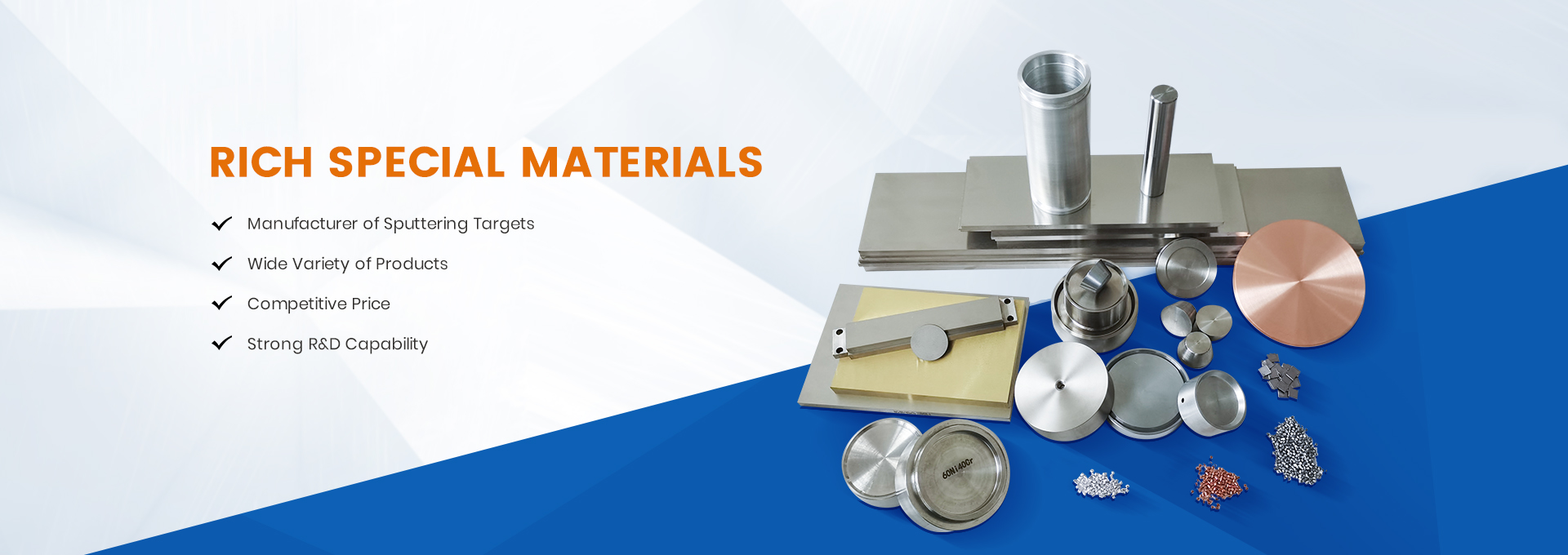
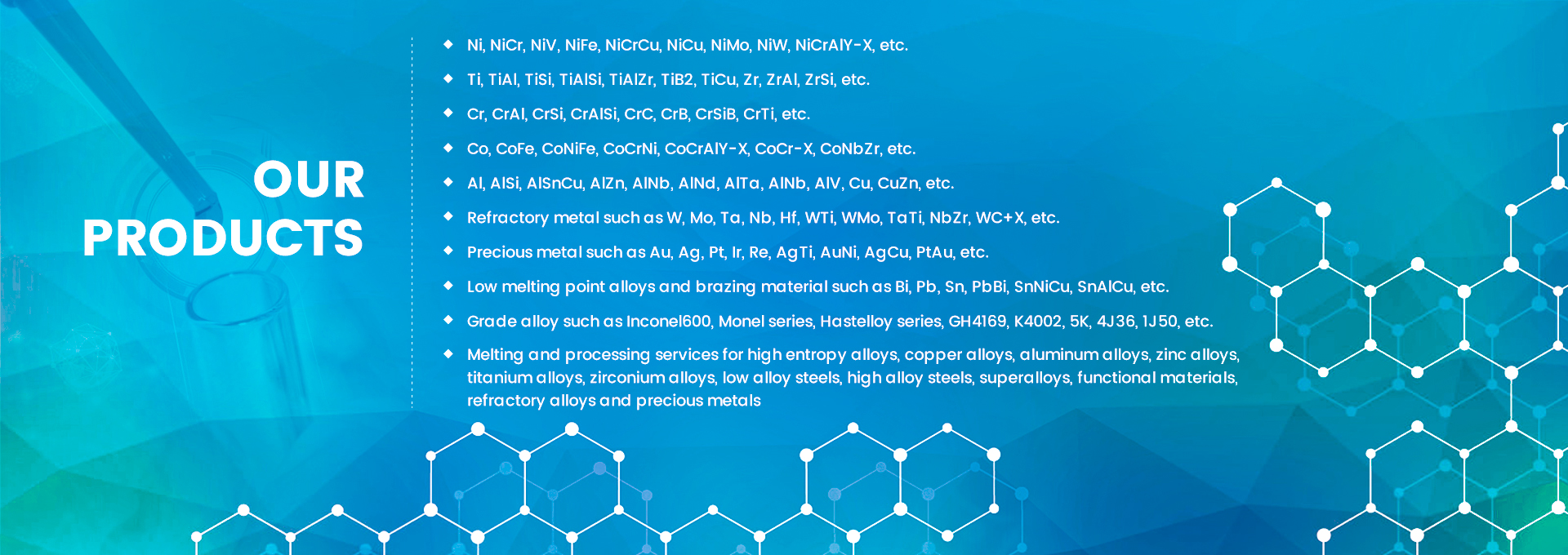



an alloy sputtering target is a PVD coating material created by uniformly fusing two or more metallic (or metallic and non-metallic) elements through specific metallurgical processes.
Hearing this, some might say: Isn’t an alloy target just a mixture of whatever materials you want, used as a raw material to deposit thin films through sputtering? If you need a certain element, just add it in, right?
The answer is clearly no.
Alloy targets are by no means a free combination of elements, nor are they a random “hodgepodge.” It’s like a master chef preparing a top-tier dish; adding one extra gram of salt or reducing sugar by a teaspoon can ruin the entire creation. Although composed of multiple raw materials, the inclusion of each element must undergo rigorous materials science screening. It requires solving deep-seated challenges like compatibility and uniformity to achieve a thin film performance where 1+1 > 2.
Behind this lies a (precision game) of “addition” and “subtraction.”
1. The Difficulty of Addition: Not All Elements Can Be “Friends”
The first challenge in creating alloy targets is the “addition” problem – fusing different elements together.
It sounds like mixing a cocktail, just pouring vodka into orange juice and shaking it. But in reality, many metals are like oil and water; they are fundamentally immiscible. Forcing them together causes one metal to “clump” within the other, like a dough with lumps of unblended dry flour.
Consider this example: You want to make a tungsten-titanium (WTi) alloy target for depositing barrier layers in chips. Tungsten has a melting point of 3422°C and a boiling point of 5555°C, while titanium’s melting point is only 1668°C and its boiling point is 3287°C – a difference of nearly double. Using traditional melting methods, titanium hasn’t fully melted before tungsten just begins to soften; by the time tungsten melts, titanium would have long since boiled and evaporated. The result is that you simply cannot obtain a uniform alloy. This is why we choose powder metallurgy for WTi alloy targets.
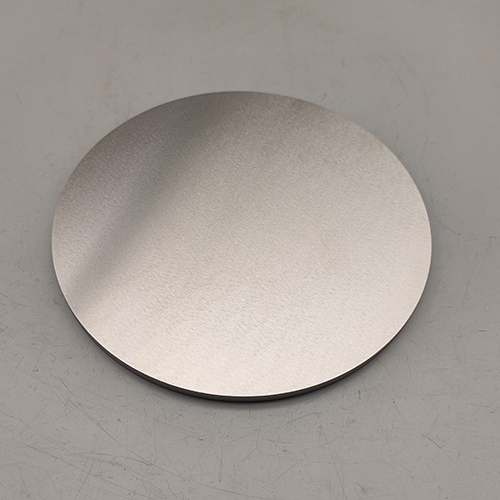
Take another example, a chromium-aluminum (CrAl) target: Chromium melts at 1857°C, aluminum at 660°C, and aluminum boils at 2519°C. The melting points differ by nearly 1200°C. If you use melting, aluminum starts melting around 660°C. By the time you reach 1857°C and chromium finally melts, while aluminum might not have fully evaporated, its composition will have drifted. More troublesome is that when molten chromium and aluminum meet, they react like two hot-tempered individuals meeting and fighting – undergoing violent metallurgical reactions, generating a mess of compounds with extremely uneven distribution, making it impossible to create a usable target. Therefore, our company also uses powder metallurgy for CrAl targets.
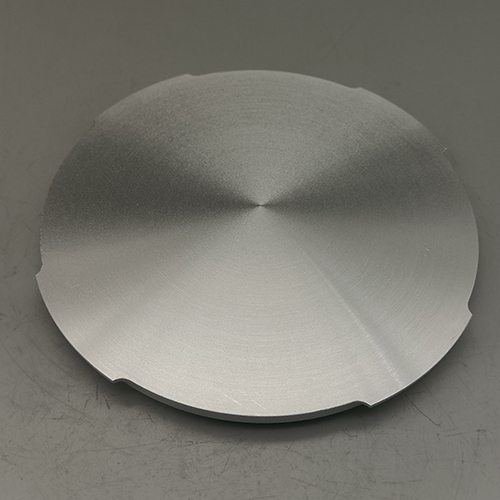
More problematic still, some elements are inherently “incompatible” – like copper and molybdenum, which are practically immiscible in the solid state. Forcing them together results in a layered structure, like oil and water separating upon standing. Sputtering with such a target yields a thin film that is alternately copper-rich and molybdenum-rich, making it completely unusable.
So, the “addition” for alloy targets isn’t a simple stacking of elements. It involves materials scientists painstakingly working, using special processes like powder metallurgy, vacuum melting, and others, to bring together pairs of “antagonists,” making them distribute uniformly and coexist peacefully.
2. Uniformity:
Having solved the issue of fusibility, the next challenge is: Is the fusion uniform enough?
You might think, “It’s a solid, how can it be non-uniform?” It can be. And it’s an invisibility to the naked eye.
Consider this: You want to make a nickel-chromium (NiCr) alloy target for precision resistor films. Nickel and chromium are mutually soluble. However, if the preparation process isn’t controlled well, chromium can segregate during cooling, enriching in certain regions. The composition of these chromium-rich areas differs from the surrounding material, and consequently, the atoms “knocked off” during sputtering from these areas also differ in composition.
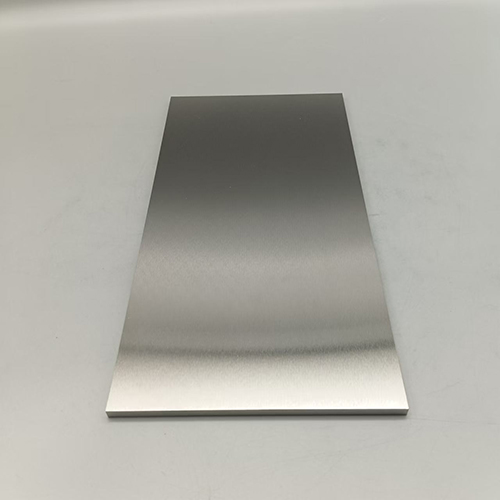
The result is a thin film deposited on the chip where some areas have more chromium (higher resistance) and others have more nickel (lower resistance). The resistance value of the entire resistor drifts unpredictably, like a faulty ruler that gives inconsistent measurements.
To achieve the required precision, materials scientists must repeatedly grind, mix, and sinter powders like kneading dough, or fully convection in the melt using electromagnetic stirring like in steelmaking.
3. The Strictness of Subtraction: Sputtering is Just a “Revealing Mirror”
If preparation is “addition,” then the sputtering process is “subtraction” – using ions to bombard the target, knocking off atoms to deposit a film.
This process has a cruel characteristic: It acts like a “revealing mirror” . Whatever is in the target ends up in the film; wherever the target is non-uniform, the film will be non-uniform. Any (hidden dangers) (planted) during the addition stage will be fully exposed during the subtraction stage.
Another example: Copper and silicon are often added to aluminum alloy targets to improve film performance. However, if copper is unevenly distributed in aluminum, forming coarse Al₂Cu intermetallic compound particles, these particles are harder to sputter than the surrounding matrix. They will gradually protrude, eventually causing “nodules” or “micro-arcing,” leading to unstable sputtering or even particulate contamination, scrapping the entire wafer.
This is like carving with a piece of wood that has a hidden defect. When you carve down to it, the defect remains, and the entire work is ruined.
Therefore, the “subtraction rule” for alloy targets demands: The “addition” must be as perfect as possible.
Conclusion
Ultimately, the “addition and subtraction” of alloy targets is a precision game about materials science.
“Addition” is about bringing incompatible elements together, uniformly, as if they were naturally one; “subtraction” is about accurately transferring the identity and position of every atom during sputtering, without deviation. Behind the seemingly free combination lies countless experiments, (corrections), and breakthroughs.
Post time: Mar-13-2026