


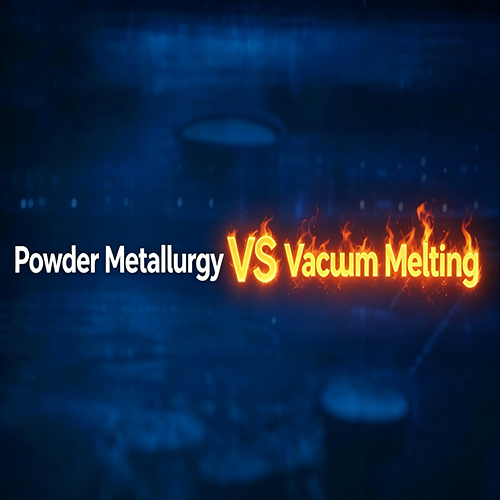
Selection Guide for Sputtering Target Manufacturing Processes: A Four-Step Decision Method for Vacuum Melting vs. Powder Metallurgy.
In high-end manufacturing fields such as semiconductor chips, flat panel displays, and photovoltaic cells, the target material is a core consumable for thin film deposition, and its quality directly determines the performance of the final product. For target manufacturers, the most fundamental and critical decision often is: for a given alloy material, should we use vacuum melting or powder metallurgy?
This choice is not just about “whether it can be made” – it determines the target’s purity, grain size, compositional uniformity, and ultimately, cost competitiveness. Drawing on industry production practices, this article presents a four-step decision method to help practitioners establish a clear process selection logic.
Step 1: Melting Point & Workability – The “Can it be made?” threshold
The first dividing line depends on the melting characteristics of the material. This is the hardest indicator – if it fails here, all subsequent considerations are moot.
Does the alloy contain high‑melting‑point metals?
Melting points of common refractory metals:
Tungsten (W): 3410°C
Tantalum (Ta): 3017°C
Molybdenum (Mo): 2620°C
Niobium (Nb): 2477°C
Chromium (Cr): 1907°C
Decision rule: If the alloy contains a large proportion of the above elements, powder metallurgy (PM) is usually the only choice. Reason: Melting requires extremely high temperatures, places severe demands on crucible materials, and the liquid metal has poor fluidity, making casting difficult. For example, Mo‑Nb alloys (both high‑melting‑point) – PM is the only feasible route.
Is there a huge difference in melting points between alloy components?
Typical example: Al‑Cr alloy – Al melts at 660°C, Cr at 1907°C, a difference of over 1200°C.
Decision rule: When the melting point difference is too large, the low‑melting‑point component (Al) will melt first, volatilize, or sink, while the high‑melting‑point component (Cr) may not fully melt, leading to severe compositional segregation. In this case, PM – by mechanically mixing powders – can more precisely control the final composition.
Step 2: Alloy Characteristics & Compatibility – The “Can it be made well?” key
If the melting points are within meltable range (generally below 1700°C), further analysis of the alloy’s intrinsic properties is needed.
Are there brittle intermetallic compounds?
Typical materials: TiAl, NiAl, etc.
Decision rule: If the alloy forms brittle phases during solidification, the cast ingot will be extremely brittle, unable to undergo subsequent rolling, forging, or other processing – it may even crack at a touch. In this case, PM can directly form the target via powder consolidation, bypassing the plasticity processing challenge. For TiAl targets, although the melting point difference can be controlled, the inherent brittleness makes PM the better choice.
Do the components immiscible or segregate in the liquid state?
Typical representative: Cu‑Cr alloy, a typical immiscible system (also called a pseudo‑alloy).
Decision rule: If the two elements are immiscible in the liquid state (like oil and water), no amount of stirring will prevent segregation upon cooling. PM is the preferred method for such immiscible alloy targets.
Step 3: End‑Use Performance Requirements – The “Is it excellent?” consideration
If the above material constraints are not significant (e.g., ordinary Al‑Cu alloy), the process route should be decided based on the target’s final application.
Are there extreme requirements on grain size?
Applications: Advanced semiconductor nodes (≤28 nm), high‑performance optical coatings. These require very fine and uniform grains to ensure uniformity of the sputtered film.
Decision rule: PM (especially hot isostatic pressing HIP or spark plasma sintering SPS) can directly produce fine‑grained targets with grain sizes controlled to micron or even sub‑micron levels. Melting produces coarse‑grained ingots that require extensive forging and rolling to break down the grains – a costly process that may not achieve the fine‑grain level of PM.
For semiconductor‑grade targets, especially for sub‑7 nm processes, the requirements on purity and microstructure are extreme: metallic impurities must be controlled to ppb levels, and grain size and orientation precisely controlled.
How high are the requirements for compositional uniformity?
Applications: Complex multi‑principal‑element alloys (high‑entropy alloys), multi‑doped alloys.
Decision rule: The more elements (e.g., 4–5 or more), the harder it is for melting to ensure uniform composition everywhere. PM, by mixing powders, can theoretically achieve atomic‑scale uniformity. For example, W‑Ni targets made by PM can keep Ni content variation within ±0.5%, avoiding ferromagnetic regions from free Ni, thus ensuring stable sputtering performance.
Step 4: Target Size & Cost – The “Is it economical?” trade‑off
What size target is needed?
Applications: Flat panel displays or large‑area architectural glass coating require oversized targets >2 m in length.
Decision rule: Currently, very large targets still rely on melting + plastic working. PM is limited by large press capacity and die size – producing oversized targets is difficult and extremely costly. Generally, PM is suitable for medium‑sized targets (200–500 mm), while melting can support large targets >500 mm.
How cost‑sensitive is the application?
Applications: General decorative coating, tool coating, etc.
Decision rule: If performance requirements are not demanding, melting is usually the lower‑cost choice due to its shorter process chain and higher efficiency. For example, 4N purity Ti targets for industrial decorative coating can be satisfied by casting; but semiconductor‑grade high‑purity Ti targets (5N) require PM or SPS.
Worked Examples: Putting the Method into Practice
Example 1: Mo‑Nb alloy target
Step 1: Mo 2620°C, Nb 2477°C – both high melting points → PM
Process ends; no further steps needed.
Example 2: TiAl alloy target
Step 1: Ti 1668°C, Al 660°C – meltable, though the large melting point difference can sometimes be controlled.
Step 2: TiAl alloy is extremely brittle, difficult to process after casting, and the shape/size is relatively complex → PM
Process ends.
Example 3: Al‑0.5%Cu target
Step 1: Low melting point – meltable.
Step 2: No refractory components, no brittle phases, liquid‑miscible.
Step 3: If for ordinary decorative coating – moderate requirements.
Step 4: If not large – either method works; if very large size or cost‑sensitive → Melting.
The Broader Perspective: Complementary Roles, Not Absolute Superiority
After reading this, you might think that powder metallurgy is better than vacuum melting.
The answer is no. In the real world of target manufacturing, these two methods have no absolute superiority – only different application scenarios. They are like left and right arms, each irreplaceable for its own domain.
Vacuum Melting: The Unshakable “Volume Leader” & “Purity King”
In many core industrial fields, vacuum melting is the absolute mainstream and first choice – PM cannot displace it.
1.High purity (especially gas impurities): This is melting’s “trump card”. In vacuum, gas impurities (O, N) and volatile impurities (K, Na, Ca) can be effectively removed. Application example: Semiconductor Al, Ti, Cu targets requiring 5N5 (99.9995%) or even higher purity, with extremely strict oxygen limits. These are almost all produced by vacuum melting + plastic working. PM, due to the large specific surface area of powders, is prone to oxidation and cannot achieve such low gas impurity levels.
2.Density & large‑size capability: Melted ingots are fully dense – critical for large‑size targets (e.g., >2.5 m Al targets for flat panel displays). Currently, only melting + rolling can economically and efficiently produce such oversized targets. PM is limited by die and HIP equipment size – either technically infeasible or prohibitively expensive.
3.Cost‑effective: For low‑melting‑point metals like Al, Cu, Zn, Sn and their alloys, melting has a short process chain, high productivity, and low cost. For tonnage targets used in architectural glass coating or decorative coating, melting is the most cost‑effective choice.
Powder Metallurgy: The “Special Forces” for Tough Problems
The value of PM lies precisely where melting cannot do it, cannot do it well, or does it too expensively.
1.Conquering the “melting” (forbidden zone): This is PM’s core value. For metals with melting points >2500°C (W, Mo, Ta) or alloys like W‑Ti, Mo‑Nb, melting is almost powerless. PM is the only way to turn them into targets.
2.Precision tailoring: When absolute compositional uniformity is required (e.g., high‑entropy alloys), or extremely fine grains (e.g., certain high‑performance optical films or advanced node targets), PM can achieve “microstructure customization” via mechanical alloying and low‑temperature sintering – a level of control melting cannot match.
PM does not replace melting; it opens up new possibilities beyond melting’s capability boundaries, turning materials that cannot be melted into high‑performance targets.
Think of the two methods as tools:
Vacuum melting is a versatile, high‑productivity tool. It handles most common materials (Al, Cu, Ti, steel…) – fast, well, and large. It’s the most‑used tool in the shop.
Powder metallurgy is a precision specialty tool. Used less often, but when the “standard tool” cannot turn a high‑strength bolt (refractory metals) or weld two materials that refuse to mix (immiscible alloys), this specialty method becomes the irreplaceable solution.
Post time: Apr-10-2026