



In the production of vacuum-melted alloy ingots, the riser is not an optional auxiliary structure but a core process unit that determines ingot density and yield. The solidification behavior of molten metal under vacuum differs significantly from that in air melting, and the function of the riser is therefore endowed with stricter technical implications. Starting from the physical nature of solidification shrinkage and combining the process characteristics of vacuum melting, this article systematically explains the necessity of risers and the direction of their technological evolution.
I. Solidification Shrinkage and Shrinkage Cavities: The Physical Basis for Risers
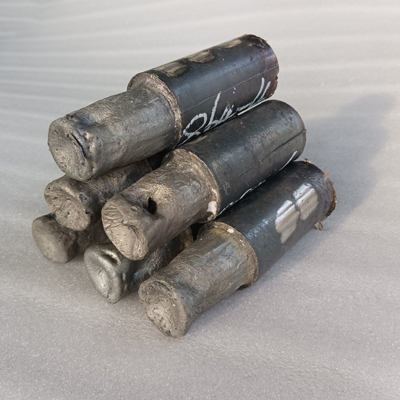
When an alloy transforms from liquid to solid, volume shrinkage is an unavoidable physical phenomenon. If this shrinkage is not continuously compensated by liquid metal, concentrated shrinkage cavities or dispersed porosity will form in the last regions to solidify—typically the upper central zone of the ingot body. The presence of shrinkage cavities not only directly reduces the effective cross-section of the ingot but also serves as a source for crack initiation and propagation in subsequent processing.
The primary function of the riser is to establish a “liquid metal reservoir” at the top of the ingot. During solidification, the metal in the riser remains liquid and continuously supplies molten metal through the feeding channel at the riser base to the shrinking region below, thereby “driving” the shrinkage cavity into the riser itself, which is then removed together with the riser during cropping. In other words, the riser sacrifices itself to be cut off in exchange for the density and integrity of the ingot body.
II. Why the Vacuum Environment Places Higher Demands on Risers
The advantage of vacuum melting lies in degassing, deoxidation, and prevention of atmospheric contamination, but this advantage brings new challenges during the solidification stage. Under vacuum conditions, the heat dissipation mechanism of molten metal differs from that in air; radiation accounts for a significantly higher proportion, and the low-pressure environment in the melting chamber makes the interfacial heat transfer behavior between the mold wall and the molten metal more complex.
More critically, the pouring temperature window for vacuum induction melting is usually narrow. The superheat of the alloy liquid during pouring is limited, and once it enters the ingot mold, if the temperature gradient between the upper and lower parts is not properly controlled, “dendrite bridging” is easily formed in the middle of the ingot—that is, dendrites at the solidification front interlock with each other, blocking the feeding channel from the upper liquid phase downward. Once the feeding channel is cut off, even if a large amount of liquid metal remains in the riser, it cannot reach the shrinkage region, and shrinkage cavity defects become unavoidable.
Therefore, the riser design for vacuum-melted alloy ingots must not merely satisfy the requirement of “having enough liquid metal”; it must also ensure that the feeding channel remains open throughout the entire solidification process.
III. The Triple Function of Risers in Vacuum Melting
First, the regulator of directional solidification. The ideal solidification sequence of an ingot should progress layer by layer from bottom to top, with the last solidification region concentrated inside the riser. The presence of the riser, combined with the cooling conditions at the mold bottom, can establish a bottom-to-top temperature gradient in the ingot. The insulating riser delays the cooling rate of the upper molten metal, keeping the riser zone liquid after the ingot body has solidified, thereby achieving continuous feeding.
Second, the trap for inclusions and segregating elements. In vacuum melting, although oxygen content is strictly controlled, non-metallic inclusions may still originate from crucible erosion or deoxidation products. These inclusions usually have a lower density than the molten metal and tend to float upward during solidification. The riser zone, as the last region to solidify, provides a gathering space for inclusions. At the same time, low-melting-point segregating elements also tend to enrich in the liquid phase; the retention of the riser allows these elements to be concentrated in the portion to be cropped, thereby reducing the degree of segregation in the ingot body.
Third, the sealing and safety barrier under vacuum conditions. Pouring operations in vacuum melting are carried out in a closed chamber, and once molten metal overflows or leaks from the top of the ingot mold, the consequences are far more serious than in air pouring. The riser structure, together with the corresponding sealing design, can effectively accommodate liquid level fluctuations during the initial pouring stage, prevent molten metal from splashing or leaking in the vacuum chamber, and ensure equipment safety.
IV. Evolution of Riser Technology: From “Increasing Size” to “Precision Insulation”
In early practice, engineers tended to extend feeding time by increasing riser volume, but this directly reduced yield—the larger the riser, the greater the cropping loss, and the more serious the waste of expensive alloy materials. The core approach of modern vacuum melting riser technology has shifted from “winning by quantity” to “exchanging efficiency through insulation.”
Insulating risers and exothermic risers are currently the mainstream solutions. By lining the riser with low-thermal-conductivity refractory materials or using materials with exothermic effects, the temperature drop of the molten metal in the riser is significantly delayed. Studies show that preheating the riser zone to above 600°C while controlling the lower part of the ingot at a lower temperature can effectively extend feeding time and reduce shrinkage cavity depth without increasing riser size. For precious materials such as nickel-based superalloys, the height optimization of insulating risers can be precise to the range of 240 to 260 mm, ensuring feeding effectiveness while avoiding excessive waste.
More advanced solutions combine vacuum insulation with electromagnetic regulation. The riser mold uses a vacuum sandwich structure to maximally block convective and conductive heat loss, while a spiral electromagnetic field is applied in the riser zone to drive the rotation of unsolidified molten metal. This rotation brings a dual effect: on the one hand, it breaks dendrites at the solidification front to prevent bridging; on the other hand, it promotes the collision, growth, and flotation of inclusions. The result is a significant reduction in riser cropping volume, and under certain conditions, the goal of “minimal or no riser cropping” can even be achieved.
V. Conclusion
Fitting risers on vacuum-melted alloy ingots is essentially about reestablishing a controllable solidification order under vacuum conditions. Without risers, solidification shrinkage would be uncompensatedly converted into shrinkage cavities and porosity, and all the purity advantages of vacuum melting would be offset by density defects in the ingot. The continuous advancement of riser technology reflects an eternal trade-off in metallurgical engineering: how to compress “necessary waste” to the lowest possible level while ensuring quality. From simply enlarging risers to precision thermal management, and further to electromagnetic-field-assisted active regulation, this evolutionary trajectory clearly points to one goal—to make every gram of alloy liquid in the riser fulfill its due feeding value, rather than merely waiting to be cropped.
Post time: Nov-12-2026