



In physical vapor deposition (PVD) magnetron sputtering, the choice of target material is a critical factor determining film performance, process stability, and production cost. Nickel (Ni) targets and chromium (Cr) targets are two of the most commonly used metal targets. However, they differ significantly in magnetic properties, sputtering behavior, film characteristics, and application scenarios. Many practitioners confuse their roles—some even mistakenly believe they can be used interchangeably.
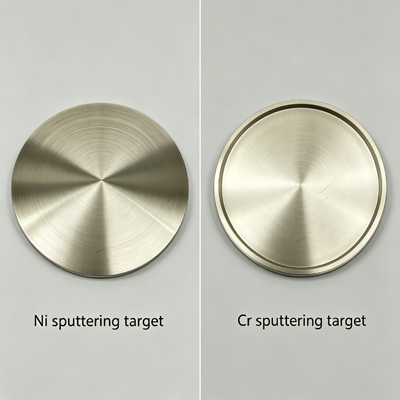
This article provides a systematic, engineering-focused comparison between nickel and chromium targets in magnetron sputtering, along with clear selection recommendations.
1. The Most Critical Underlying Difference: Magnetic Properties
Although nickel and chromium are adjacent in the periodic table, they belong to different worlds in terms of magnetic behavior.
| Property | Nickel Target | Chromium Target |
|---|---|---|
| Magnetism | Ferromagnetic (Curie point ~358°C) | Non‑ferromagnetic |
| Effect on Magnetic Field | The target itself “shorts” the magnetron’s magnetic field | The magnetic field penetrates the target normally |
| Sputtering Stability | Poor; prone to ignition difficulties and arcing | Good; wide process window |
What does this mean in practice?
In a conventional DC magnetron sputtering system, a chromium target can be installed and used directly—ignition is easy and deposition rates are stable. A nickel target, due to its ferromagnetism, significantly weakens the horizontal magnetic field at the target surface, leading to:
Difficulty igniting the plasma or even inability to strike a discharge
Deposition rate dropping by more than 50%
Reduced target utilization
Poor process repeatability
Solutions: When using a nickel target, you typically need:
Ultra‑thin targets (thickness ≤3 mm)
Unbalanced magnetron sputtering sources
Strong magnetic targets (high‑coercivity magnets)
If your equipment uses a conventional planar target, a chromium target is the safer and more economical choice.
2. Comprehensive Comparison of Film Properties
Even when deposition is successful, the physical and chemical properties of nickel and chromium films are completely different.
| Property | Nickel Film | Chromium Film |
|---|---|---|
| Hardness (HV) | 300–600 | 1000–1300 |
| Wear Resistance | Moderate | Excellent |
| Salt Spray Corrosion Resistance | Excellent (especially in alkaline media) | Good |
| Acid Resistance | Good | Excellent (due to passive film) |
| Film Internal Stress | Low | Relatively High |
| Adhesion to Glass/Ceramics | Excellent | Moderate |
| Adhesion to Metals | Good | Good |
| Resistivity (μΩ·cm) | 6.9 | 12.9 |
| Color | Warm silver‑gray | Cool silver‑white with bluish tint |
| Maximum Service Temperature (in air) | ~600°C (oxidation) | ~700°C (forms Cr₂O₃) |
Summary:
Chromium film: Hard, wear‑resistant, scratch‑resistant – suitable as a protective top layer.
Nickel film: Softer, tougher, excellent adhesion, alkali‑resistant – suitable as an interlayer or adhesion layer.
3. Typical Application Scenarios
Typical Applications of Nickel Targets
- Adhesion/Underlayer in Multilayer Films
Nickel has excellent adhesion to glass, ceramics, and polymers. In optical or electronic coatings, a very thin nickel layer (1–5 nm) is often deposited first, followed by functional layers such as gold, silver, or copper, to prevent delamination. - Corrosion‑Resistant Coatings
In alkaline environments or marine atmospheres, nickel films perform better than chromium films. Some chemical valves and fasteners use nickel coatings for corrosion protection. - Electromagnetic Shielding
Nickel has good magnetic permeability and electrical conductivity, making it suitable for electromagnetic shielding layers inside electronic devices. - Thin Film Resistors
Pure nickel films can be used to prepare thin‑film resistors with moderate resistance values.
Typical Applications of Chromium Targets
- Decorative and Wear‑Resistant Topcoats
The silver‑white “chrome color” on faucets, bathroom fittings, automotive wheels, and eyeglass frames comes from chromium films. Their high hardness effectively resists everyday scratching. - Mold and Tool Coatings
Chromium coatings on injection molds, stamping dies, and cutting tools significantly increase service life. - High‑Temperature Oxidation‑Resistant Coatings
Chromium forms a dense chromium oxide (Cr₂O₃) layer at high temperatures, withstanding air environments up to ~700°C. It is used in some engine components. - Precision Thin‑Film Resistors
Chromium films have moderate resistivity and a low temperature coefficient of resistance (TCR), suitable for high‑precision thin‑film resistors.
4. Selection Decision Table
Use the following table to make a quick decision based on your specific needs:
| If your primary requirement is … | Recommended Target | Reason |
|---|---|---|
| High hardness and scratch resistance | Chromium | Hardness is 2–3 times that of nickel |
| Adhesion to glass/ceramics | Nickel | Strong interfacial bonding with oxides |
| Alkaline corrosion resistance | Nickel | Nickel is extremely stable in alkalis |
| Acid corrosion resistance | Chromium | Chromium’s passive film resists acids |
| Electromagnetic shielding | Nickel | Combines conductivity and magnetic permeability |
| Aesthetic cool silver color | Chromium | The classic “chrome” appearance |
| Low‑temperature sputtering process | Chromium | Non‑magnetic, simple process |
| Thin‑film resistor layer | Both | Choose according to required resistance value |
5. Common Questions and Misconceptions
Misconception 1: “Nickel and chromium targets can be freely substituted for each other.”
False. Their magnetic properties are fundamentally different. Replacing a chromium target with a nickel target may prevent plasma ignition. Film properties are also completely different, so they cannot be swapped arbitrarily.
Misconception 2: “Nickel films are not corrosion resistant.”
Fact: Nickel has excellent corrosion resistance in alkaline media and marine environments. It is only vulnerable to strong acids, especially oxidizing acids like concentrated nitric acid.
Misconception 3: “Chromium films are wear resistant under all conditions.”
Fact: Chromium films have high hardness and excellent resistance to abrasive wear and scratching. However, under high impact or counter‑body wear conditions, their low toughness can lead to brittle spalling.
Misconception 4: “Any magnetron sputtering system can deposit nickel.”
Fact: Sputtering ferromagnetic materials (nickel, iron, cobalt) with a conventional DC planar target is very difficult. Special high‑strength magnetic targets or thin‑target designs are required. Always verify equipment compatibility before purchasing a nickel target.
6. Process Operating Recommendations
Using a Chromium Target (Standard Process)
- Sputtering pressure: 0.3–0.8 Pa (Ar)
- Power density: 3–8 W/cm²
- Deposition rate: typically 10–30 nm/min (depending on equipment)
- Power supply: DC or medium frequency (MF) power supply recommended
Using a Nickel Target (Special Considerations)
- Target thickness: recommended ≤3 mm
- Magnet selection: use strong neodymium magnets or an unbalanced magnetic field structure
- Operating pressure: can be increased to 0.8–1.5 Pa to enhance ionization
- Ignition technique: ignite at high pressure (~2 Pa), then adjust to operating pressure
- Power supply: MF or pulsed DC is more stable than DC
7. Summary and One‑Sentence Recommendation
| Scenario | One‑Sentence Choice |
|---|---|
| Need a wear‑resistant / decorative top layer | Choose Chromium |
| Need an adhesion underlayer | Choose Nickel |
| Equipment is a conventional planar magnetron | Choose Chromium (Nickel may not work) |
| Require alkali / seawater corrosion resistance | Choose Nickel |
| Require high hardness and cool white color | Choose Chromium |
Final advice: If you have only a standard magnetron sputtering system without a high‑strength magnetic target configuration, chromium is the safer, day‑to‑day choice. Nickel targets are suitable for specialized production lines or R&D platforms capable of handling ferromagnetic materials.
Before full‑scale production, always perform trial runs with small samples to verify film properties and process stability—this is an essential step that no target selection can bypass.
Post time: May-29-2026