



Metal targets are core materials in thin-film deposition processes such as physical vapor deposition (PVD), magnetron sputtering, and electron beam evaporation, widely used in semiconductors, optics, photovoltaics, and tool coatings. Among them, pure metal targets (single-element targets) are particularly important in advanced coating technologies due to their high purity, compositional simplicity, and stable performance. This article explores the fabrication processes, key performance parameters, applications, and future trends of pure metal targets by integrating fundamental characteristics with in-depth analysis.
Fundamental Properties of Metal Targets:
1. Definition and Classification
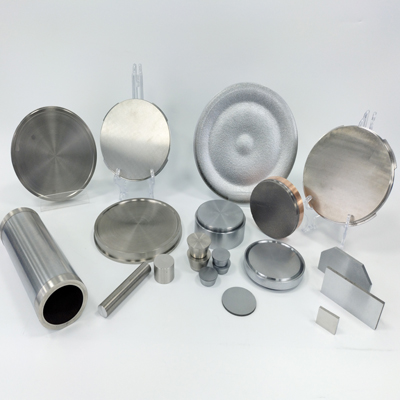
Metal targets are typically made of high-purity metals or alloys, available in shapes such as discs, rectangles, and tubes. They can be categorized into:
Pure metal targets (e.g., Cu, Ti, Au)
Alloy targets (e.g., Ti-Al, Ni-Cr)
Compound targets (e.g., ITO, ZnO)
2. Key Performance Requirements
High Purity (≥99.9%): Prevents impurities from affecting film properties.
High Density (≥98%): Reduces particle ejection during sputterin
Uniform Microstructure: Fine and evenly distributed grains ensure coating consistency.
3. Fabrication of Pure Metal Targets
3.1 Comparison of Major Fabrication Methods
| Method | Suitable Metals | Advantages | Disadvantages |
|---|---|---|---|
| Melting + Rolling | Cu, Al, Ag, Au, etc. | High purity, low cost, high density | Not suitable for refractory metals (W, Mo) |
| Powder Metallurgy | W, Mo, Ti, Ta, etc. | Complex shapes, controllable composition | Requires HIP for densification |
| Electrodeposition | Ni, Co, etc. | Suitable for ultrathin targets, nanostructure control | Difficult impurity control, lower mechanical strength |
3.2 Key Process Optimizations
Hot Isostatic Pressing (HIP): Enhances density in powder metallurgy targets.
Precision Machining: Ensures dimensional accuracy and surface finish .
Backplate Bonding: Uses In or Ag solder to prevent cracking due to thermal expansion mismatch.
4.Applications of Pure Metal Targets
4.1 Semiconductor Industry
Copper (Cu) Targets: Used in IC interconnects, requiring purity ≥99.999%.
Aluminum (Al) Targets: Employed in wafer metallization, with controlled Si content to prevent electromigration.
4.2 Display and Photovoltaics
Silver (Ag) Targets: Applied in solar cell electrodes for high reflectivity and conductivity.
Indium (In) Targets: Used in ITO transparent conductive films for touchscreens and OLEDs.
4.3 Tool and Protective Coatings
Titanium (Ti) Targets: Produce wear- and corrosion-resistant TiN coatings.
Tungsten (W) Targets: Used in high-temperature protective coatings for aerospace components.
Pure metal targets are critical materials in advanced thin-film deposition, with their performance and fabrication processes directly influencing coating quality. As industries such as semiconductors and renewable energy advance, targets will evolve toward higher purity, larger sizes, and greater sustainability. Innovations in materials (e.g., high-entropy alloys) and manufacturing (e.g., 3D printing) will further drive technological breakthroughs in target production.
Post time: Sep-03-2025