


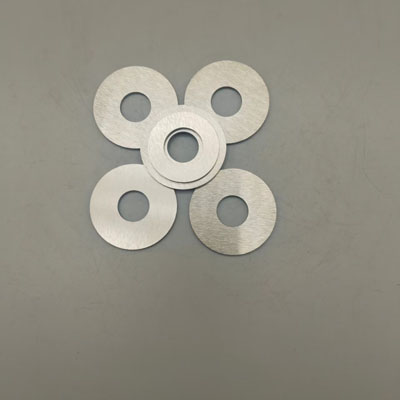
Manganese Copper M2052 Damping alloy is a specialized high-damping functional material used for vibration and noise reduction. It is not an ordinary support gasket, but rather a structural-functional integrated component that effectively converts mechanical vibration energy into thermal energy. The table below provides a quick overview of its core characteristics:
| Characteristic Dimension | Specific Description |
|---|---|
| Chemical Composition (at%) | Mn-20Cu-5Ni-2Fe (Approx. 73% Mn, 20% Cu, 5% Ni, 2% Fe) |
| Core Damping Mechanism | Primarily relies on the movement of twin boundaries within the alloy under vibrational stress to dissipate energy |
| Key Mechanical Properties | Tensile strength can high, while also possessing excellent processability |
| Damping Performance Characteristics | Damping capacity increases as temperature decreases and is sensitive to vibration frequency and strain amplitude |
| Main Application Fields | Aerospace, precision instruments, energy, marine systems, nuclear industry, and other fields with stringent requirements for vibration and noise |
Unique Value as a Gasket
When M2052 alloy is made into a gasket, its value becomes evident:
Passive Vibration Damping: It does not require external energy input; it effectively attenuates vibration through the friction and movement of the internal twin boundaries within the material itself.
Balances Strength and Toughness: While providing high damping performance, its 500 MPa tensile strength ensures the mechanical strength and load-bearing capacity required for a gasket.
Adapts to Complex Working Conditions: This material maintains good damping performance even in low-temperature environments. Furthermore, through modern additive manufacturing technologies like selective laser melting, complex-shaped gaskets can be manufactured to meet special structural needs.
In summary, the Manganese Copper M2052 gasket is a high-tech vibration damping solution. It is particularly suitable for precision equipment, aerospace vehicles, or special industrial environments where requirements for vibration and noise control are extremely high, effectively serving the dual roles of “vibration damper” and “structural component.” It maintains good damping performance at room temperature.
I hope this information is helpful. If you have a specific application scenario in mind, perhaps we can explore it further.
Post time: Nov-13-2025