


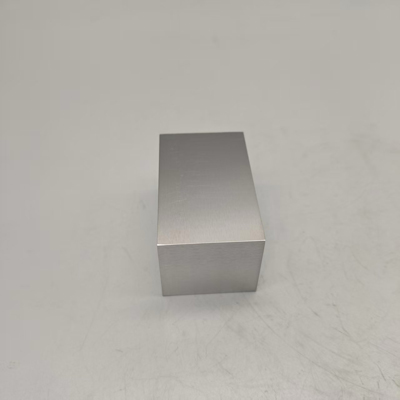
Cobalt-Chromium-Molybdenum (CoCrMo) alloy F1537 is a high-performance cobalt-based alloy that complies with the ASTM F1537 standard. Due to its excellent wear resistance and biocompatibility, it has become the core material for load-bearing implants such as artificial hip and knee joints. When manufactured as a sputtering target for Physical Vapor Deposition (PVD) coating processes, it can deposit a functional cobalt-chromium-molybdenum coating on medical or industrial components, providing high hardness, wear resistance, and corrosion resistance.
Material Designation and Standard
F1537 is the ASTM standard number for Wrought Cobalt-28Chromium-6Molybdenum Alloy for Surgical Implants. This standard primarily covers two grades with different carbon contents (cobalt content is the balance, i.e., the remainder after specifying other elements):
| Grade (UNS Number) | Carbon Content (C) | Typical Application |
|---|---|---|
| Low Carbon (UNS R31537) | ≤ 0.14% | Applications requiring higher toughness and corrosion resistance |
| High Carbon (UNS R31538) | 0.15% – 0.35% | Applications with extreme demands for wear resistance |
In addition to ASTM F1537, this material also complies with relevant international standards such as ISO 5832-12 and ASTM F799.
Chemical Composition and Characteristics
The excellent performance of this material stems from its precise alloy composition:
Cobalt (Co): The matrix element, providing excellent hot strength and corrosion resistance, ensuring dimensional stability.
Chromium (Cr): Content 26.0% – 30.0%. Chromium forms a dense chromium oxide passive film on the material’s surface, imparting excellent corrosion resistance in human body fluids or salt spray environments.
Molybdenum (Mo): Content 5.0% – 7.0%. Molybdenum refines grain size, enhances passive film stability, and significantly increases yield strength and creep resistance through solid-solution strengthening.
Nickel (Ni): Content ≤ 1.0%. The extremely low nickel content ensures biocompatibility, reducing the risk of allergic reactions caused by metal ion release.
Physical and Mechanical Properties
The performance data of F1537 alloy is key to its use as both a target material and an implant:
Density: Approximately 8.25 – 8.30 g/cm³, classifying it as a relatively heavy metal material.
Melting Point: Approximately 1350 – 1450 °C, requiring a high-energy heat source for melting when used as a target.
Hardness:
Annealed condition: approximately 20 – 35 HRC.
After warm working: hardness can increase to 35 – 45 HRC (typical value).
Tensile Strength: In annealed condition, ultimate tensile strength is not less than 897 MPa (approx. 130 ksi), yield strength is not less than 517 MPa (approx. 75 ksi).
Elastic Modulus: Approximately 240 GPa, significantly higher than human bone, ensuring stability under load-bearing as an implant.
Comparison of Different Grades
As F1537 includes low-carbon and high-carbon grades, their performance focuses and application scenarios differ slightly:
| Property | Low Carbon (UNS R31537) | High Carbon (UNS R31538) |
|---|---|---|
| Key Feature | Better toughness and corrosion resistance | Better wear resistance and high strength |
| Microstructure | Finer, more uniformly distributed carbides | More abundant hard carbides for better wear resistance |
| Typical Applications | Knee implants, dental materials with high toughness requirements | Hip joint femoral heads, bearing surfaces requiring extreme wear resistance |
| Machinability | Relatively easier to machine | More demanding on cutting tools due to higher hardness |
Key Performance Advantages
The combination of properties makes this material difficult to replace in specific fields:
Extremely High Wear Resistance: This is its core competitive advantage. During friction, the material’s surface forms a very hard, work-hardened layer. Combined with dispersed hard carbides acting as a “skeleton”, its scratch resistance and wear resistance far exceed those of stainless steel.
Excellent Biocompatibility and Corrosion Resistance: The chromium oxide passive film on the surface remains almost “inert” in the harsh electrochemical environment of the human body. This results in an extremely low release rate of metal ions (e.g., cobalt, chromium), making the overall biological safety very reliable.
High Strength and Good Fatigue Performance: Especially for materials produced via forging or powder metallurgy (e.g., Micro-Melt® technology), achieving a uniform, fine grain structure significantly improves fatigue strength and ultimate tensile strength. This is crucial for implants bearing long-term cyclic loads.
Post time: Jun-09-2026