


Aluminum plays the role of a “light yet conductive” element in the periodic table. Pure aluminum has a resistivity of about 2.65 μΩ·cm, second only to silver and copper, yet its cost is much lower, and its adhesion to silicon wafers and glass is also good. These foundations make aluminum-based films one of the most widely used metal film categories in semiconductor interconnects, flat panel displays, optical coatings, and photovoltaic cells. However, pure aluminum has a fatal weakness—it is too “soft.” Under the driving force of current, aluminum atoms diffuse rapidly along grain boundaries, leaving voids or forming hillocks in interconnect lines. When aluminum contacts silicon, mutual diffusion occurs at high temperatures, creating “spikes” at the interface that penetrate shallow junctions. The industry’s solution is straightforward: dope aluminum with “additives.” Silicon, copper, chromium, vanadium, niobium, tantalum, molybdenum, tin—the addition of each alloying element trades aluminum’s easy processability and low density for a specific thin-film property. This article reviews the product system, key performance, and typical applications of aluminum-based targets by functional combination.
I. Pure Aluminum Targets: Basic Conduction and Reflection
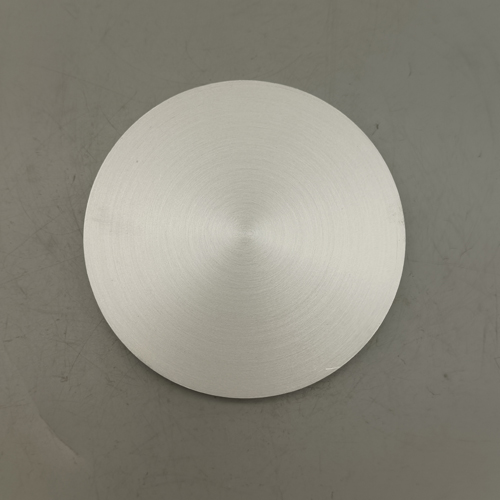
The purity of pure aluminum targets ranges from 4N (99.99%) to 6N5 (99.99995%). Ultra-high-purity aluminum for semiconductors generally requires 5N5 and above, while 5N is mainstream in flat panel displays. Product forms include planar targets and rotary targets. Through optimized thermomechanical processing, the average grain size of industrial-grade high-purity aluminum targets can be controlled within 90 μm. The grain size of rotary aluminum targets used in G8.5 generation lines shows a normal distribution, ensuring stable sputtering rates and consistent film thickness.
The primary application areas of pure aluminum targets are scenarios that demand high conductivity and reflectivity but have relatively less stringent reliability requirements: OLED conductive layers, reflective layers in optical coatings, and back electrodes for thin-film solar cells. The back-surface reflection of aluminum films can reflect unabsorbed sunlight back to the absorption layer, improving the cell’s light absorption efficiency.
II. Conductive Interconnect Portfolio: Al-Si, Al-Cu, Al-Si-Cu
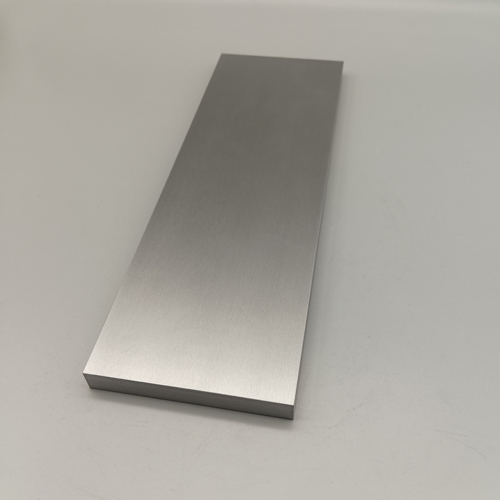
When an aluminum film is in direct contact with a silicon substrate, silicon dissolves into aluminum during heat treatment and precipitates at the interface upon cooling, forming spikes that penetrate shallow junctions and causing device short circuits. The approach of Al-Si targets (typical composition Al-1Si) is to pre-add silicon at near-saturation concentration (~1 wt%) into aluminum, reducing the silicon concentration gradient at the interface and suppressing silicon dissolution and re-precipitation. Resistivity is between 2.6 and 3.5 μΩ·cm, slightly higher than that of pure aluminum, but this is traded for significantly improved device reliability. Al-Si is mainly used for contact hole filling in integrated circuits and interconnect underlayers in direct contact with silicon. Al-Si alloys also possess semiconductor characteristics between those of metals and ceramics, and the resulting films can be used for Low-E glass and chip packaging layers.
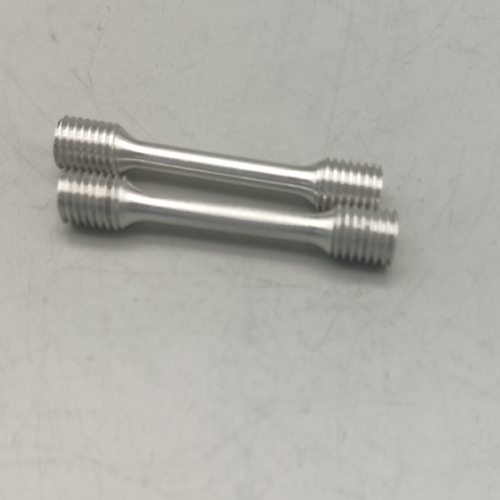
Electromigration is another fatal problem for aluminum interconnects. Under current stress, aluminum atoms diffuse along grain boundaries, forming voids or hillocks. Al-Cu targets (copper content 0.5–4 wt%) use the segregation of copper atoms at aluminum grain boundaries to block diffusion paths. The addition of copper can greatly increase the electromigration activation energy—a common method is to add 1–4% copper to aluminum; copper atoms reduce the grain-boundary diffusion effect, thereby significantly improving electromigration resistance. The purity of Al-Cu targets is generally 5N; copper must be uniformly distributed and must not form coarse Al₂Cu precipitates. They are mainly used for integrated circuit interconnects, redistribution layers in advanced packaging, and vertical interconnects in 3D NAND.
Al-Si-Cu ternary targets (typical composition Al-1Si-0.5Cu) integrate the above two mechanisms: silicon suppresses interdiffusion at the Al-Si interface, while copper blocks electromigration paths at aluminum grain boundaries. Target purity can reach 5N5, and grains can be refined below 25 μm. Grain refinement also brings an additional benefit: abnormal arcing is less likely during sputtering, and re-sputtered deposits are less likely to grow on the target surface, preserving target life and sputtering efficiency. Al-Si-Cu is a mature choice for metallization layers in VLSI/ULSI devices, balancing reliability and process compatibility.
III. Tool and Hard Coating Portfolio: Al-Cr, Al-V-Cr, Al-Ti-Zr-V-Mo-Ta
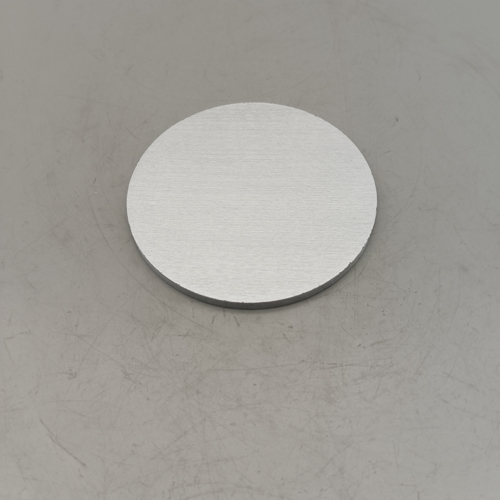
Al-Cr targets are the most mature variety of aluminum-based targets for machining applications. The addition of aluminum improves the brittleness of pure chromium and makes the target easier to machine, while chromium gives the film hardness and wear resistance. Its core use is reactive sputtering: Al-Cr targets deposit CrAlN coatings in a nitrogen atmosphere, with hardness reaching superhard levels and oxidation resistance above 900 °C. Because CrAlN coatings maintain high hardness and oxidation resistance at elevated temperatures, machine tools can use higher feed rates during cutting, thereby increasing cutting speed and workpiece surface quality. The microstructure of Al-Cr targets is usually designed as an interpenetrating two-phase structure of a chromium phase and a Cr-Al alloy phase, with the area fraction of the chromium phase controlled at 10–35% and the Cr-Al alloy phase at 65–90%, and an average grain size not exceeding 18 μm, to achieve better coating uniformity and machinability. High-chromium Cr-Al alloys also exhibit antiferromagnetic properties and can serve as anti-magnetic shielding layers in chip packaging, blocking interference from external scattered magnetic fields.
Al-V-Cr targets advance tool coatings toward multi-component systems. The aluminum matrix provides lightweight characteristics, while vanadium and chromium synergistically improve hardness and wear resistance; they are used for wear-resistant coatings and tool coating applications. Al-Ti-Zr-V-Mo-Ta is an extremely multi-component combination, with the melting points of the six elements spanning from 660 °C for aluminum to 3017 °C for tantalum. The design goal of this “high-entropy” aluminum-based target is to form a multi-principal-element solid solution or nanocomposite structure in the film, pursuing lightweight characteristics together with high-temperature strength, wear resistance, corrosion resistance, and radiation resistance. At present, such targets remain mainly at the research and specialty application stage, representing a frontier direction in the evolution of aluminum-based targets from function-oriented alloying to multi-principal-element design.
IV. Refractory Metal Strengthening Portfolio: Al-V, Al-Nb, Al-Ta, Al-Mo
Vanadium, niobium, and tantalum all belong to Group VB, and their aluminum-based alloy targets overlap in two directions: integrated circuit wiring and high-temperature structural materials.
Al-V targets have a clear positioning in the semiconductor field: as a new wiring material for large-scale integrated circuits. Al-V alloy films have relatively low resistivity, good thermal stability, and radiation resistance. They can effectively suppress electromigration failure while maintaining conductivity close to that of high-purity aluminum.
Al-Nb targets take advantage of the high melting point, low density, and excellent high-temperature strength of intermetallic compounds formed by niobium and aluminum. They are used for high-temperature components of aeroengines, spacecraft, and nuclear reactors, and also for depositing superconducting films and wear- and corrosion-resistant coatings. Al-Ta targets inherit the high chemical stability and corrosion resistance of tantalum, while aluminum improves processability. They are used in the flat panel display industry, optical coatings, and high-temperature protective films.
V. Lightweight and Anti-Friction Portfolio: Al-Mg-Si, Al-Sn, Al-Sn-Cu, Al-Zn
Al-Mg-Si is a thin-film version of 6xxx-series aluminum alloy, with a density of about 1.8 g/cm³ and a coefficient of thermal expansion of 24 μm/m-K. After heat treatment, it can achieve a uniform, isotropic grain structure. It is used for decorative coatings, corrosion-resistant films, and structural layers in electronic devices.
Al-Sn targets have a broad range of applications. In lithium batteries, Al-Sn films serve as anode materials, and their distribution design can buffer volume expansion during charge and discharge. In semiconductor interconnects, they are used for diffusion barrier layers and optical reflective coatings. In EUV lithography, they are used in tin-based target systems, where the tin concentration in the Sn-Al alloy is adjusted to optimize plasma opacity.
The primary application of Al-Sn-Cu targets is bearing shell anti-friction layers. Typical composition is 15–25 wt% tin and 0.8–1.4 wt% copper, prepared by spray forming. In PVD bearing shell production, an AlSn20Cu alloy layer is used as an anti-friction layer together with a nickel barrier layer, improving the load-bearing capacity and service life of the bearing shell. Studies show that introducing periodic aluminum target sputtering to interrupt the normal growth of tin crystals can reduce the size of tin particles in AlSnCu coatings; these fine tin particles exhibit better friction-reducing performance under both dry friction and lubricated conditions.
In electronic thin films, Al-Zn targets are used to deposit AZO transparent conductive films by reactive sputtering, for Low-E glass, touch screens, and liquid crystal display devices. Metallic Al-Zn targets can be fabricated as large-size monolithic targets, offering clear advantages on large-scale coating production lines. In traditional industry, Al-Zn alloys are also used for wear-resistant bearing shells, sliding blocks, and other components.
From pure aluminum to Al-Ti-Zr-V-Mo-Ta, the product family of aluminum-based targets is essentially a trade-off table of “what part of aluminum is traded for what.” Pure aluminum addresses the basic needs of conduction and reflection; Al-Si manages interdiffusion at silicon-contact interfaces; Al-Cu manages electromigration lifetime; Al-Si-Cu packages the two problems together; Al-Cr and Al-V-Cr support the hardness and oxidation resistance of tool coatings; Al-V, Al-Nb, Al-Ta, Al-Mo, each hold their own positions between semiconductor wiring and high-temperature structures; Al-Sn-Cu and Al-Zn hold the ground in anti-friction and transparent conduction. Through combinations on the periodic table, the element aluminum has transformed itself from a “soft but conductive” metal into a complete materials family covering purities from 4N to 6N5 and applications from semiconductors to photovoltaics, displays, aviation, and tools.
Post time: Sep-27-2026